
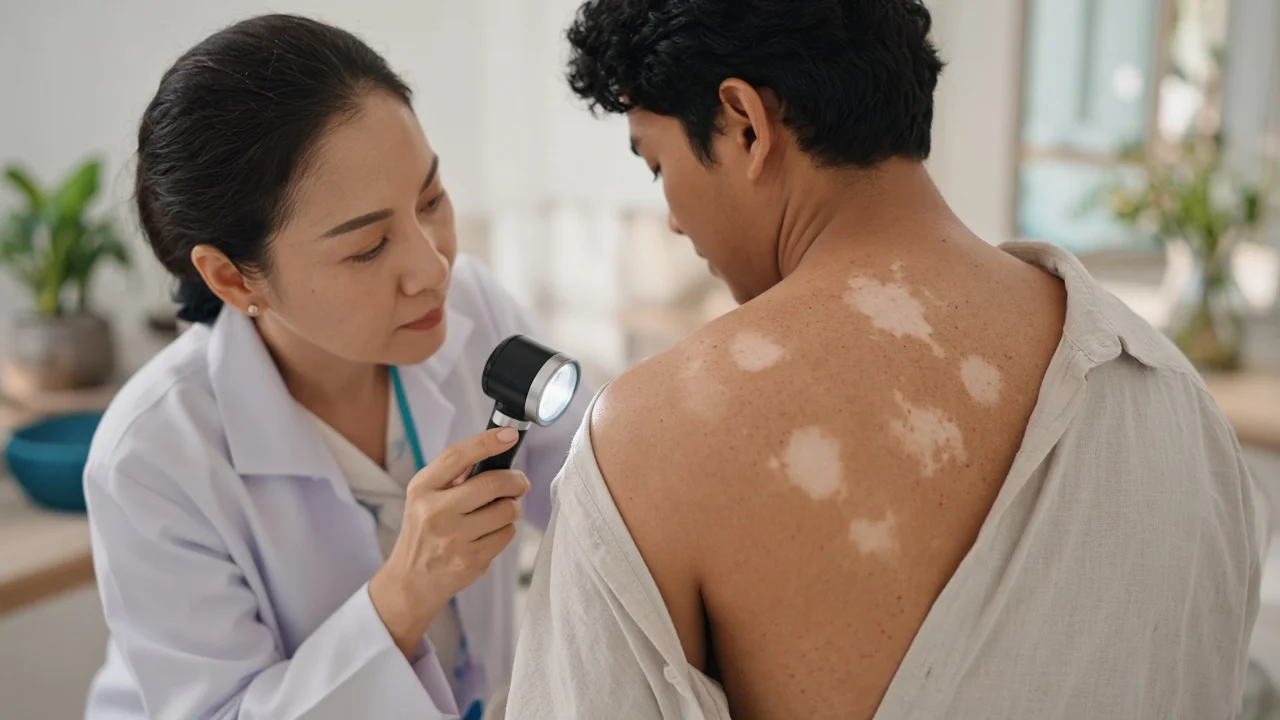
Pale patches that appear after a few weeks of island sun are one of the most common skin questions we hear — and the usual cause is not the sun itself.
What causes white spots on skin in a tropical climate? The most common cause is tinea versicolor, a harmless overgrowth of yeast that normally lives on skin, which hot, humid weather and sweating encourage. The spots show up more as surrounding skin tans. Other causes include small sun-related white dots, pityriasis alba and, less often, vitiligo, so a doctor’s diagnosis matters before treatment.
The most common cause: tinea versicolor
A yeast, not dirt
The American Academy of Dermatology explains that tinea versicolor happens when a yeast that normally lives on skin overgrows, triggered by hot, humid weather, lots of sweating and oily skin. It affects people of all skin colours and is not a sign of poor hygiene.
Why it shows up on holiday
The patches stop tanning normally, so they appear whiter as the surrounding skin tans. The AAD notes that in non-tropical areas it often fades in cool, dry months — and that in tropical climates it can return easily.
Other causes of white spots
Small sun-related white dots
The Cleveland Clinic describes idiopathic guttate hypomelanosis as benign white dots, like little raindrops, on sun-exposed skin such as the arms and legs, thought to be linked to long-term sun exposure.
Pityriasis alba and vitiligo
Pityriasis alba causes slightly scaly, lighter patches, mostly in children and often linked to eczema. Vitiligo is an autoimmune condition causing smooth, milk-white patches that can spread and needs medical treatment.
Telling the common causes apart
| Cause | Typical look | Where | Usual approach |
|---|---|---|---|
| Tinea versicolor | Pale, pink or tan patches with fine scale | Chest, back, shoulders, neck | Antifungal washes, creams or tablets |
| Sun-related white dots | Small, flat, sharply defined dots | Shins, forearms | Sun protection; options are limited |
| Pityriasis alba | Faint, slightly scaly pale patches | Face, arms; mostly children | Moisturising; often fades |
| Vitiligo | Smooth, milk-white patches | Anywhere, often hands and face | Dermatologist-led treatment |
| Post-inflammatory lightening | Pale area after a rash or injury | Wherever the skin was inflamed | Time and sun protection |
For orientation only — several of these look alike, and only an examination confirms the cause.
How tinea versicolor is treated
Diagnosis
The AAD says dermatologists can often diagnose it by looking, sometimes using a skin scraping or a Wood’s lamp, under which affected skin can look yellowish-green.
Treatment and recovery
Antifungal shampoos, washes or creams — often with selenium sulfide, ketoconazole or pyrithione zinc — are the usual first step, with tablets reserved for widespread or recurrent cases. The yeast clears fairly easily, but skin may stay uneven for weeks or months before the colour returns.
Habits that help in hot, humid weather
Ways to reduce flare-ups while living on or visiting the islands:
- Shower soon after sweating or exercise
- Wear loose, breathable cotton or linen
- Change out of damp swimwear or gym clothes promptly
- Avoid heavy, oily body products on the chest and back
- Use sunscreen so the surrounding skin does not tan as strongly
- Ask a doctor about a preventive antifungal wash if it keeps coming back
Step-by-step: what to do if you notice white spots
A sensible sequence:
- Note where the spots are, when they appeared and whether they itch or scale.
- Take clear photos in daylight for comparison.
- Avoid harsh scrubs, bleaching creams or lemon juice on the patches.
- Use sunscreen on the area and the skin around it.
- Book a skin assessment so the cause can be confirmed.
- Follow the treatment plan for the full recommended course.
- Review progress after several weeks, remembering colour can take longer to return.
When to see a doctor promptly
Changing or spreading patches
Smooth, milk-white patches that spread, patches near the eyes or lips, or any spot that is sore, bleeding or changing should be checked soon.
Recurring every hot season
If tinea versicolor returns repeatedly, a doctor can discuss preventive treatment rather than repeated self-treatment.
Skin assessment at LIV Clinic
Diagnosis before treatment
At LIV Clinic on Koh Samui and Koh Phangan, Dr. Narathai examines pale patches to confirm the cause before suggesting treatment, and refers on when a specialist is needed.
Read next
See our skin treatments, read how to fade dark marks from mosquito bites, or book a consultation.
Frequently asked questions
What causes white spots on skin in a tropical climate?
Most often tinea versicolor, a harmless yeast overgrowth encouraged by heat, humidity and sweating. Sun-related white dots, pityriasis alba and vitiligo are other possible causes.
Is tinea versicolor contagious?
It is caused by yeast that normally lives on everyone’s skin, so it is not considered something you catch from other people.
How long does it take for white spots to go away?
With tinea versicolor, the yeast clears fairly quickly with treatment, but skin colour can take weeks to months to even out.
Will the sun fix white spots?
Not reliably. Tanning usually makes the patches more noticeable, so sunscreen is a better approach while they recover.
Can white spots be vitiligo?
Sometimes. Vitiligo usually causes smooth, milk-white patches without scale that can spread. A doctor should assess any patches like this.
Can I treat white spots myself?
Mild tinea versicolor is often treated with antifungal washes, but because several conditions look alike, it is best to confirm the cause first.
Safety and consultation
Any new white patch on the skin needs a proper diagnosis — several different conditions look alike, some need prescription treatment and a few need a dermatologist, so self-treating the wrong cause can delay the right care. Results vary from person to person, and no specific outcome can be promised. This article is general information, not medical advice.
At LIV Clinic, every treatment begins with an in-person assessment by Dr. Narathai Vichienkalayarut, M.D., who reviews your skin, medical history and goals before recommending a personalized plan. Book a consultation to find out whether this treatment suits you.
LIV Clinic — “Live Your Life Young”
Doctor-led aesthetic and wellness clinic on Koh Samui and Koh Phangan, serving both international visitors and local residents.
Koh Samui (Bophut): 1/63 Thaweeratpakdee Rd, Bo Put, Koh Samui, Surat Thani 84320 · Tel 065-996-4242
Koh Phangan: 116/16 Moo 1, Koh Phangan, Surat Thani 84280 · Tel 093-254-5259
LINE: @Livclinic · Book a consultation
Explore our skin treatment and laser services.
ฆสพ.สฎ. 78/2567