
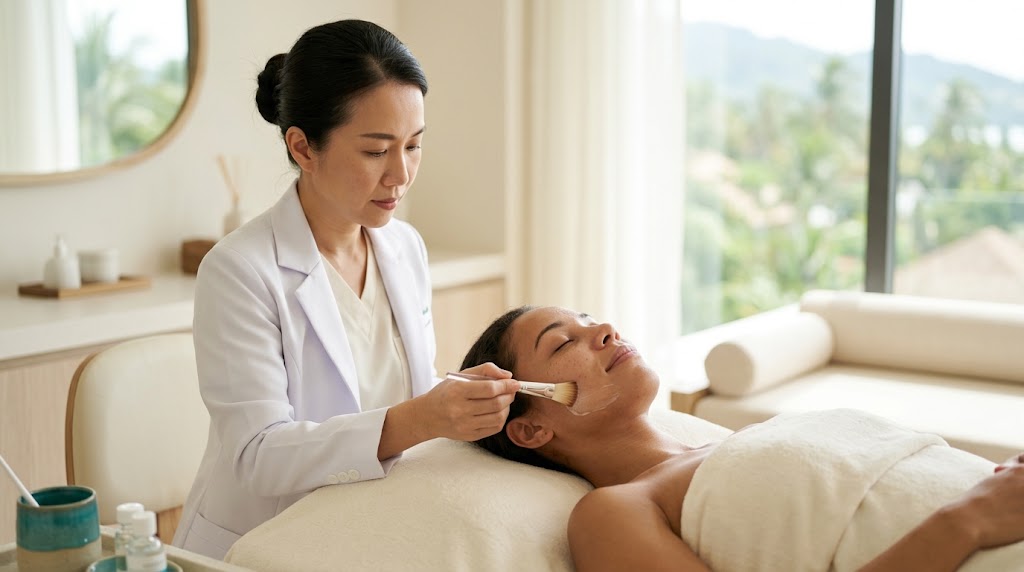
Peels are one of the oldest tools in dermatology and still one of the most useful — handled with respect.
Where can I get a chemical peel on Koh Samui? Chemical peels are available at licensed, doctor-led clinics such as LIV Clinic, where the peel type and depth are matched to your skin — which matters particularly in a high-UV climate and for more pigmented skin, where the wrong peel can worsen pigmentation.
What a chemical peel does
Controlled exfoliation
An acid solution is applied to remove damaged surface layers in a controlled way, prompting the skin to renew with better texture and tone.
Depth determines everything
Superficial peels work on the outer layer with minimal downtime, while medium and deeper peels reach further and do more — with correspondingly more recovery and risk.
What peels treat well
Peels are commonly used for:
- Dull, uneven skin tone
- Rough or congested texture
- Mild pigmentation and post-acne marks
- Fine lines from surface photoaging
- Mild acne and clogged pores
Peel depths compared
| Depth | Typical acids | Downtime |
|---|---|---|
| Superficial | Glycolic, lactic, salicylic | Minimal, mild flaking |
| Medium | TCA, stronger glycolic | Several days peeling |
| Deeper | Higher-strength agents | Significant; medical only |
Depth should be chosen by a clinician based on your skin type and concern.
Peels and pigmentation
Useful, but with care
For melasma, guidance places peels as a third-line option after topicals and lasers, with glycolic acid and TCA peels showing the greatest efficacy among peel types.
The risk of worsening pigment
Because inflammation can drive pigmentation, an overly aggressive peel on more pigmented skin can make discolouration worse — the main reason depth and skin type must be matched carefully.
Why the tropics change the calculation
Post-peel skin is vulnerable
Freshly peeled skin is more sensitive to UV, and Koh Samui’s year-round sun raises the risk of post-inflammatory pigmentation.
Plan around beach time
Peels and an intensive beach schedule do not mix well — plan a quieter week and be diligent with sun protection afterwards.
What to expect
During and after
You may feel tingling or stinging during application. Afterwards, expect redness and some flaking depending on depth, settling over days.
A course usually works better
Superficial peels are typically done as a course a few weeks apart, giving gradual, cumulative improvement.
Who should be cautious
Discuss carefully or avoid if you:
- Have active infection or broken skin in the area
- Are prone to keloid scarring
- Have recently used isotretinoin
- Are pregnant or breastfeeding
- Have significant recent sun exposure or sunburn
- Have a history of post-inflammatory pigmentation
Preparing for and recovering from a peel
A practical routine:
- Have a consultation so peel type and depth suit your skin.
- Avoid sun exposure and tanning for two weeks beforehand.
- Pause retinoids and strong acids as advised before treatment.
- Plan a quieter few days after a medium or deeper peel.
- Do not pick or peel flaking skin — let it shed naturally.
- Use broad-spectrum sun protection daily afterwards.
Chemical peels at LIV Clinic Koh Samui
At LIV Clinic, peel type and depth are chosen by Dr. Narathai to suit your skin type and concern. Read about treating sun damaged skin, or book a consultation.
Frequently asked questions
Where can I get a chemical peel on Koh Samui?
At licensed, doctor-led clinics such as LIV Clinic, where the peel type and depth are matched to your skin type — important in a high-UV climate and for more pigmented skin.
What do chemical peels treat?
Dull and uneven tone, rough or congested texture, mild pigmentation and post-acne marks, fine surface lines, and mild acne. Deeper concerns need other treatments.
Are chemical peels safe for darker skin?
They can be, but depth and acid choice must be conservative. Overly aggressive peels on more pigmented skin can worsen discolouration through post-inflammatory pigmentation.
How much downtime does a peel need?
Superficial peels cause minimal downtime with mild flaking, while medium peels involve several days of peeling. Deeper peels require significant recovery and are medical-only.
Can I have a peel during a beach holiday?
It is not ideal. Freshly peeled skin is more sensitive to UV, and strong sun raises the risk of pigmentation. Plan a quieter few days and be diligent with sun protection.
How many peels will I need?
Superficial peels are usually done as a course a few weeks apart, giving gradual, cumulative improvement. Your plan is confirmed at consultation.
Safety and consultation
A chemical peel is a medical procedure and, like any energy-based or resurfacing treatment, carries some risk — common temporary effects can include redness, mild swelling and sensitivity, while less common effects such as pigment changes are minimised by correct settings for your skin type. Results vary from person to person, and no specific outcome can be promised. This article is general information, not medical advice.
At LIV Clinic, every treatment begins with an in-person assessment by Dr. Narathai Vichienkalayarut, M.D., who reviews your skin, medical history and goals before recommending a personalized plan. Book a consultation to find out whether this treatment suits you.
LIV Clinic — “Live Your Life Young”
Doctor-led aesthetic and wellness clinic on Koh Samui and Koh Phangan, serving both international visitors and local residents.
Koh Samui (Bophut): 1/63 Thaweeratpakdee Rd, Bo Put, Koh Samui, Surat Thani 84320 · Tel 065-996-4242
Koh Phangan: 116/16 Moo 1, Koh Phangan, Surat Thani 84280 · Tel 093-254-5259
LINE: @Livclinic · Book a consultation
Explore our laser and skin and Thermage services.
ฆสพ.สฎ. 78/2567