
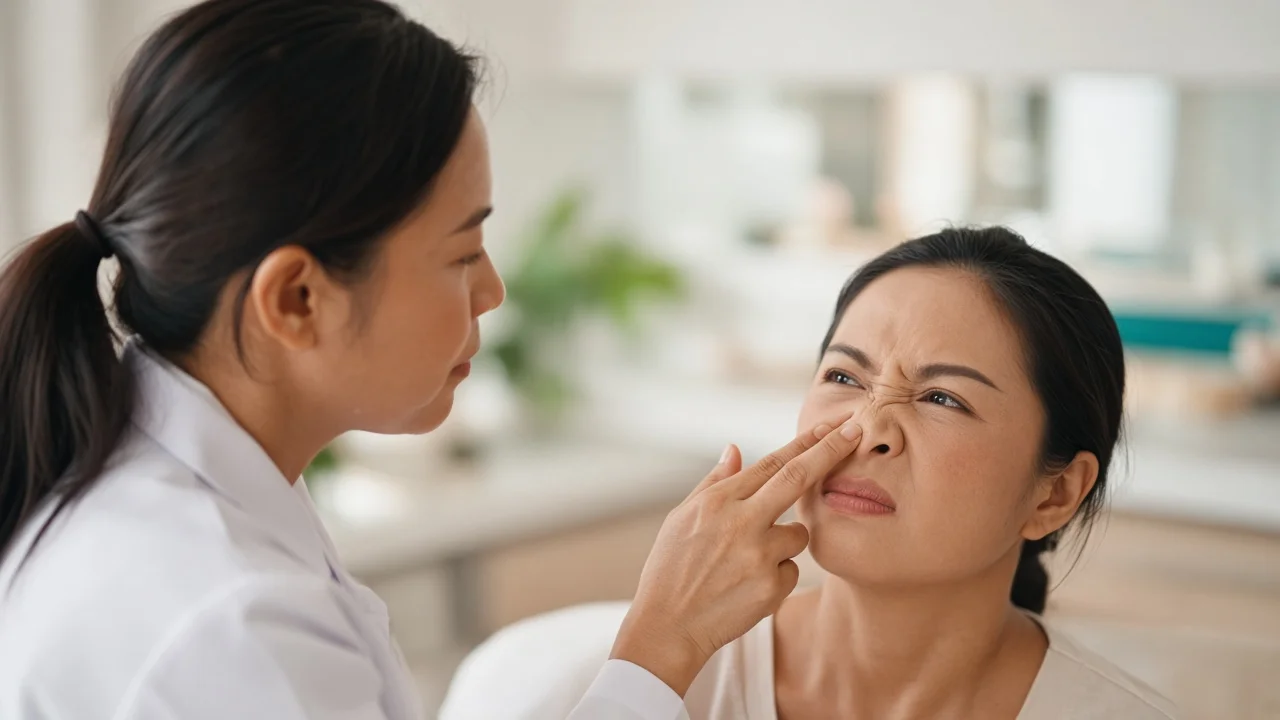
They show up in photographs long before anyone notices them in the mirror — two small diagonal creases either side of the nose.
What are bunny lines and can Botox treat them? Bunny lines are the diagonal creases that appear on either side of the bridge of the nose when you scrunch, squint or smile strongly, caused by the nasalis muscle. Yes — a very small dose of botulinum toxin placed carefully in that muscle softens them, and it is a common add-on to frown-line treatment.
What bunny lines are
The nasalis muscle
Bunny lines — sometimes called scrunch lines — are the short diagonal creases that run across the upper sides of the nose. They are produced by the nasalis muscle pulling the nose upward and inward when you squint, sniff or smile broadly.
Why the name
The nose-scrunching movement that creates them resembles a rabbit twitching its nose, which is where the informal name comes from.
Why they appear
Expression habits
Some people naturally recruit the nasalis muscle when they smile or squint. In a bright, sunny climate, frequent squinting makes this more pronounced.
The compensation effect
Bunny lines sometimes become more obvious after frown-line treatment, because the frown muscles are softened and the nose area works slightly harder in strong expression. This is one of the most common reasons people first notice them.
How Botox treats bunny lines
A small, precise dose
Botulinum toxin temporarily blocks the nerve signals that make a muscle contract, as the Cleveland Clinic describes. Placed superficially in the nasalis, a few units per side are usually enough to soften the crease.
Why precision matters
The muscles that lift the upper lip sit immediately below. Product that diffuses too low can affect the smile or upper-lip movement, so this is a small-volume, shallow-placement treatment.
Treatment at a glance
| Element | Typical approach |
|---|---|
| Injection points | 1–2 per side, upper nose |
| Units per side | A very small number — confirmed at consultation |
| Onset | Softening from about day 3 |
| Full effect | 10–14 days |
| Duration | About 3–4 months |
| Commonly combined with | Frown-line and crow’s-feet treatment |
Illustrative only; your doctor confirms dosing based on how strongly the muscle moves.
Who it suits, and who it does not
Worth considering if:
- You see diagonal nose creases in photographs when you smile
- You have noticed them more since having your frown lines treated
- You squint often in bright sunlight
- You are already having upper-face treatment and want a balanced result
- The creases are visible in expression rather than etched at rest
Less suitable
If the lines are deeply etched at rest, or if the appearance is mostly from sun damage and thin skin, a skin treatment plan addresses more than toxin will.
Possible side effects specific to this area
Upper-lip and smile effects
Because the lip elevators are close by, the main area-specific risk is a temporary change in how the upper lip moves or an asymmetric smile. Conservative dosing and shallow placement make this unlikely.
The usual injectable effects
Pinpoint redness, mild tenderness and occasional small bruising apply here as elsewhere. The MedlinePlus entry lists symptoms that should prompt medical attention.
Step-by-step: preparing for bunny line treatment
A short preparation sequence:
- Photograph your face smiling broadly and squinting, in natural daylight.
- Check whether the creases are visible when your face is completely relaxed.
- Book a consultation and ask whether the nasalis is genuinely the cause.
- Mention if you have had frown-line treatment, as compensation may be the trigger.
- Agree a very conservative dose, given how close the lip muscles sit.
- Avoid alcohol and blood-thinning supplements for 24–48 hours beforehand, where appropriate.
- Review at about two weeks to check smile symmetry and decide on any top-up.
Bunny line treatment at LIV Clinic
Treated as part of the whole upper face
At LIV Clinic on Koh Samui and Koh Phangan, Dr. Narathai assesses how your nose, frown and eye muscles work together rather than treating a single crease in isolation.
Read next
See our Botox and wrinkle programme, explore dermal filler for volume-related nose and midface changes, or book a consultation.
Frequently asked questions
What are bunny lines and can Botox treat them?
Bunny lines are the diagonal creases on either side of the nose bridge, caused by the nasalis muscle scrunching the nose. A small, precisely placed dose of botulinum toxin softens them.
Why have my bunny lines got worse since having Botox?
Softening the frown muscles can mean the nose area works slightly harder in strong expression, making the creases more noticeable. Treating the nasalis alongside usually resolves it.
How many units are needed for bunny lines?
Only a few per side. It is a small-volume treatment because the muscles that lift the upper lip sit immediately below and must not be affected.
Can treating bunny lines affect my smile?
It can temporarily if product diffuses to the lip elevators, which is why dosing is conservative and placement shallow. Any such effect is temporary and uncommon with experienced injection.
How long does bunny line treatment last?
Usually about three to four months, in line with other upper-face treatment. The effect builds over 10 to 14 days and longevity varies by individual.
Can bunny lines be treated on their own?
Yes, though they are most often treated as an add-on alongside frown lines or crow’s feet so the upper face looks balanced rather than one area being smoother.
Safety and consultation
Bunny line Botox is a prescription medical treatment and, like any injectable, carries some risk — common temporary effects can include redness, swelling, bruising, mild headache or a short-lived heaviness, and less common reactions such as temporary eyelid or brow droop are possible. Results vary from person to person, and no specific outcome can be promised. This article is general information, not medical advice.
At LIV Clinic, every treatment begins with an in-person assessment by Dr. Narathai Vichienkalayarut, M.D., who reviews your skin, medical history and goals before recommending a personalized plan. Book a consultation to find out whether this treatment suits you.
LIV Clinic — “Live Your Life Young”
Doctor-led aesthetic and wellness clinic on Koh Samui and Koh Phangan, serving both international visitors and local residents.
Koh Samui (Bophut): 1/63 Thaweeratpakdee Rd, Bo Put, Koh Samui, Surat Thani 84320 · Tel 065-996-4242
Koh Phangan: 116/16 Moo 1, Koh Phangan, Surat Thani 84280 · Tel 093-254-5259
LINE: @Livclinic · Book a consultation
Explore our Botox and wrinkle and dermal filler services.
ฆสพ.สฎ. 78/2567