
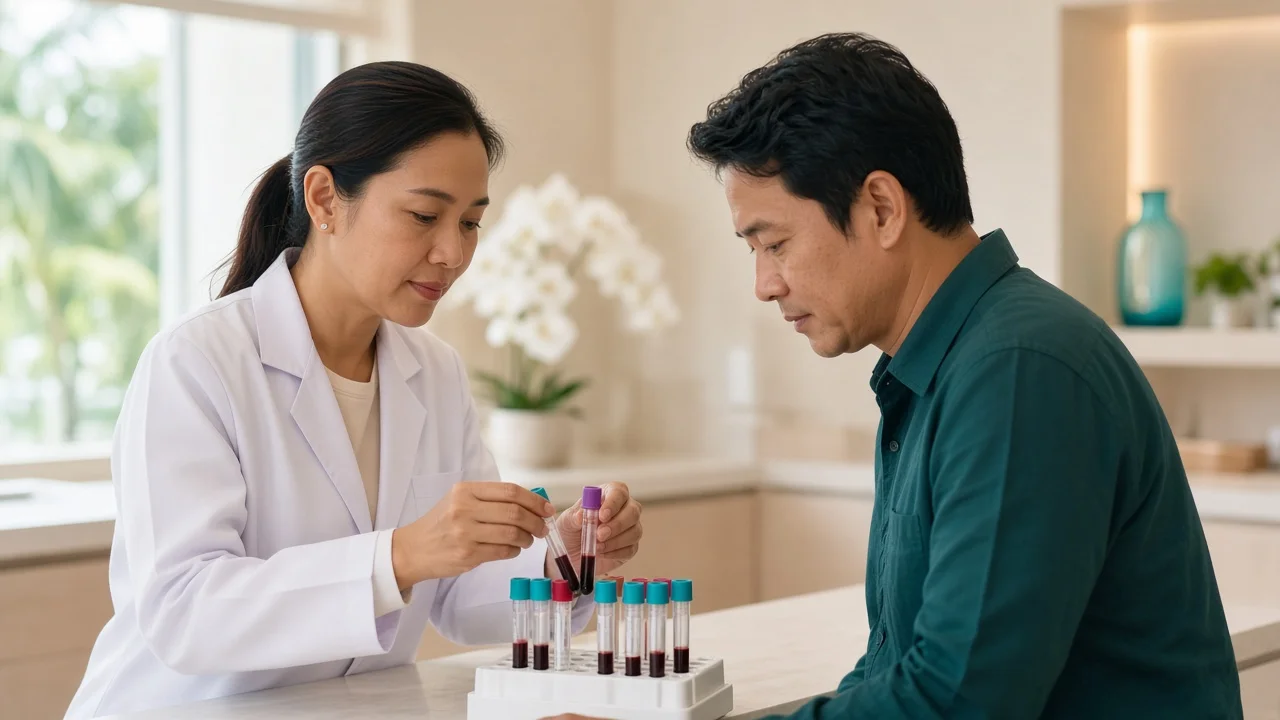
Both come from your own blood. The difference is in how the tube is spun — and what that means once it is injected.
What is the difference between PRP and PRF? PRP (platelet-rich plasma) is made by spinning your blood with an anticoagulant so it stays liquid, giving a concentrated plasma. PRF (platelet-rich fibrin) is spun more slowly without an anticoagulant, so it forms a fibrin gel that may release growth factors more gradually. Evidence for PRP in skin and hair is larger; PRF is newer.
Where both treatments start
Your own blood
Both begin with a small blood draw from the arm. The blood is spun in a centrifuge to separate the platelet-rich portion, which contains growth factors involved in tissue repair. The Cleveland Clinic explains how PRP is prepared and used.
Then the methods diverge
The key differences are whether an anticoagulant is added and how fast and long the tube is spun.
How PRP is made
Anticoagulant and a faster spin
An anticoagulant keeps the blood liquid. One or two spins concentrate the platelets into plasma, which is drawn up and injected into the scalp or skin.
What that means in practice
Growth factors are released relatively quickly after injection. PRP is the more established option, with more studies for hair loss and skin rejuvenation.
How PRF is made
No anticoagulant, gentler spin
PRF is spun more slowly and without additives, so it begins to form a fibrin network that traps platelets and white cells. Reviews such as this one in the medical literature describe it as a later-generation platelet concentrate.
The proposed advantage
The fibrin matrix may release growth factors over a longer period. Because it starts to clot, it must be used quickly after preparation.
PRP and PRF compared
| PRP | PRF | |
|---|---|---|
| Anticoagulant | Yes | No |
| Spin | Faster, sometimes two spins | Slower, single spin |
| Texture | Liquid plasma | Liquid that turns into a gel (fibrin) |
| Growth factor release | Faster | Possibly more gradual |
| Evidence in aesthetics | Larger body of studies | Newer, growing evidence |
| Common uses | Hair loss, skin quality, under-eye | Skin quality, under-eye, hair (emerging) |
A simplified comparison. Protocols vary between devices and clinics.
What the evidence shows
Promising, not definitive
A comparative review notes that PRF shows encouraging results in tissue healing, but head-to-head trials in cosmetic dermatology are limited and methods differ widely between studies.
Realistic expectations
Neither is a cure for hair loss or ageing. Both usually need a course of sessions, and results vary with the cause of hair loss, age and overall health.
Who may not be suitable
Platelet treatments are usually avoided or postponed if you have:
- A blood or platelet disorder, or very low platelet counts
- Active infection or skin inflammation in the treatment area
- Active cancer or current chemotherapy
- Recent use of medicines that affect platelets, unless your doctor agrees
- Pregnancy or breastfeeding, where most clinics prefer to wait
- Unrealistic expectations of a single-session result
Step-by-step: choosing between PRP and PRF
A practical way to decide with your doctor:
- Clarify your goal: hair shedding, thinning, skin texture or under-eye quality.
- Have the cause of hair loss assessed before any injection.
- Ask which method the clinic uses and why it suits your goal.
- Ask how many sessions are recommended and at what interval.
- Share your medicines and medical history, including blood disorders.
- Agree how progress will be measured, such as standardised photos.
- Review results after the course before committing to maintenance.
Platelet treatments at LIV Clinic
Assessment before method
At LIV Clinic on Koh Samui and Koh Phangan, Dr. Narathai assesses the cause of hair or skin concerns before recommending any platelet treatment. Availability of PRF varies — confirm with the clinic.
Read next
See our skin treatment page, read about PRP for skin rejuvenation, or book a consultation.
Frequently asked questions
What is the difference between PRP and PRF?
PRP is made with an anticoagulant and a faster spin, producing liquid concentrated plasma. PRF uses no anticoagulant and a slower spin, forming a fibrin gel that may release growth factors more gradually.
Is PRF better than PRP for hair loss?
Not proven. PRP has more published evidence for hair loss. PRF is promising, but direct comparison studies are limited, so the choice depends on your doctor’s assessment.
Does PRF hurt more than PRP?
Both involve a blood draw and injections, so the sensation is similar. Discomfort depends more on the area treated and the use of numbing.
How many sessions of PRP or PRF are needed?
A course of several sessions spaced a few weeks apart is common, followed by maintenance. Your doctor confirms the plan after assessment.
Are PRP and PRF safe?
Because they use your own blood, allergic reactions are unlikely. Temporary redness, swelling, tenderness or bruising are common, and infection is a rare risk.
Can PRP or PRF be combined with other treatments?
Yes, they are sometimes combined with microneedling or prescribed hair-loss treatments. Your doctor decides the safest combination.
Safety and consultation
PRP or PRF treatment is a medical procedure and carries some risk — common temporary effects include redness, swelling, tenderness and bruising at the blood-draw and injection sites, and less common reactions such as infection are possible. Results vary from person to person, and no specific outcome can be promised. This article is general information, not medical advice.
At LIV Clinic, every treatment begins with an in-person assessment by Dr. Narathai Vichienkalayarut, M.D., who reviews your skin, medical history and goals before recommending a personalized plan. Book a consultation to find out whether this treatment suits you.
LIV Clinic — “Live Your Life Young”
Doctor-led aesthetic and wellness clinic on Koh Samui and Koh Phangan, serving both international visitors and local residents.
Koh Samui (Bophut): 1/63 Thaweeratpakdee Rd, Bo Put, Koh Samui, Surat Thani 84320 · Tel 065-996-4242
Koh Phangan: 116/16 Moo 1, Koh Phangan, Surat Thani 84280 · Tel 093-254-5259
LINE: @Livclinic · Book a consultation
Explore our skin and hair treatment and IV drip and wellness services.
ฆสพ.สฎ. 78/2567