
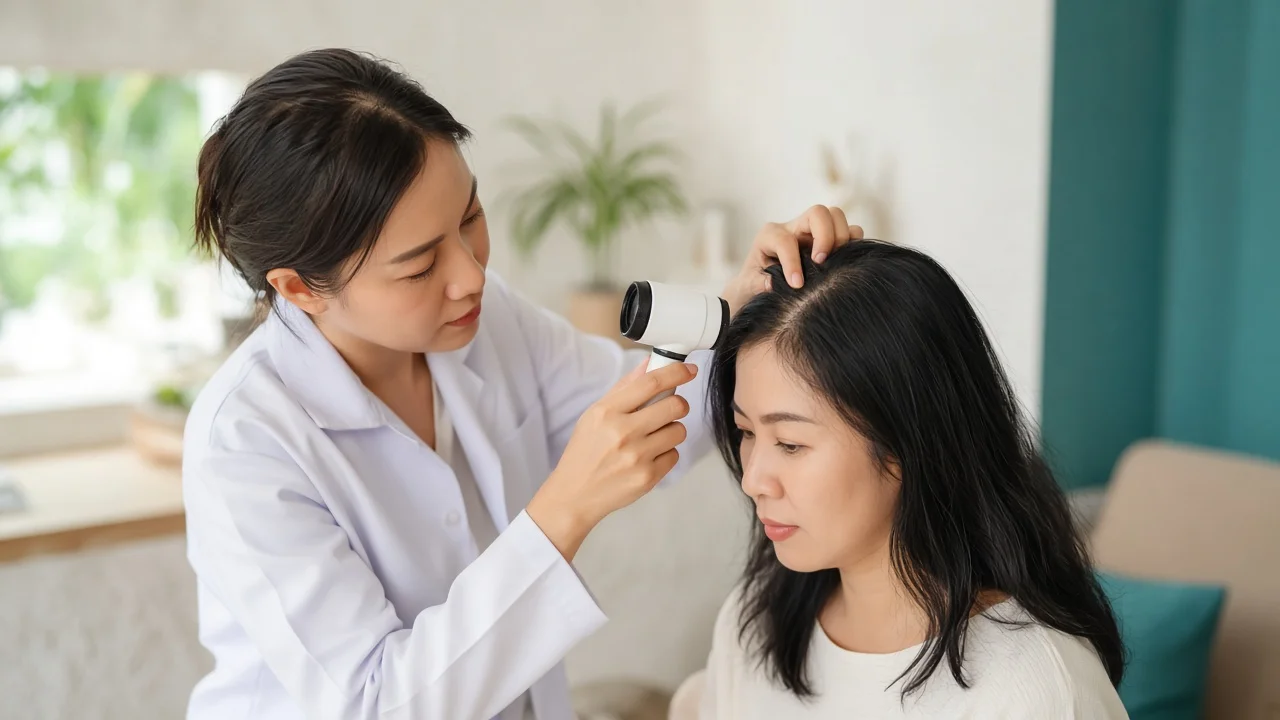
Postpartum hair loss can look alarming in the shower drain, but in most women it is a temporary shift in the hair cycle rather than true thinning.
Can PRP help with hair loss after pregnancy? Usually it is not needed. Postpartum hair loss is most often telogen effluvium — temporary shedding that peaks around four months after birth and returns to normal by about the baby’s first birthday. PRP is studied mainly for pattern hair loss, so it is worth considering only if thinning persists or a doctor finds another cause.
Why hair falls out after pregnancy
A shift in the hair cycle
During pregnancy, more hairs stay in the growth phase. After birth they move into the resting phase together and shed a few months later. The American Academy of Dermatology calls this telogen effluvium — excessive shedding rather than permanent loss.
The typical timeline
The AAD says shedding usually peaks about four months after giving birth and that most women regain normal hair growth by their child’s first birthday, some sooner.
Does PRP help postpartum shedding?
Usually not necessary
Because postpartum telogen effluvium tends to recover on its own, treatment aimed at regrowth often adds little. Gentle hair care and time are usually enough.
Where PRP may have a role
PRP has been studied mostly for pattern hair loss. If pregnancy has unmasked or accelerated pattern thinning that is still present after recovery would be expected, PRP may be discussed as one part of a plan — after a proper diagnosis.
Postpartum shedding vs other causes
| Pattern | More likely cause | Usual next step |
|---|---|---|
| Diffuse shedding peaking 3–4 months after birth | Postpartum telogen effluvium | Reassurance, gentle care, time |
| Shedding still heavy after 12 months | Persistent effluvium or another cause | See a doctor for assessment |
| Widening parting or thinning crown | Possible female pattern hair loss | Diagnosis; options may include PRP |
| Patchy bald spots | Possible alopecia areata | Dermatologist assessment |
| Shedding with tiredness or feeling cold | Possible thyroid or iron issue | Blood tests via your doctor |
For orientation only; only an examination can confirm the cause.
Gentle hair care while it recovers
Habits that reduce breakage during the shedding phase:
- Use a mild shampoo and a light conditioner on the ends
- Avoid tight ponytails, braids and hair extensions
- Let hair air-dry where you can, and lower heat on tools
- Use a wide-tooth comb on wet hair
- Eat regularly and keep up any supplements your doctor advised
- Protect your scalp and hair from strong sun with a hat
When to see a doctor
After about a year
The AAD advises seeing a dermatologist if hair has not regained its normal fullness after one year, because another cause may be involved. The Cleveland Clinic also describes postpartum hair loss as temporary in most cases.
Sooner if something seems different
Bald patches, scalp redness or scaling, or shedding with other symptoms such as exhaustion, palpitations or feeling cold are reasons to book earlier.
Step-by-step: what to do about postpartum hair loss
A practical sequence:
- Note when the shedding started relative to the birth.
- Switch to gentle hair care and loose styles.
- Take a photo of your parting and hairline once a month in the same light.
- Mention the shedding at your postnatal check-up.
- If shedding is still heavy after about a year, book a hair assessment.
- Ask whether blood tests are needed before any treatment.
- Discuss options such as PRP only once a cause is identified — and tell the doctor if you are breastfeeding.
Breastfeeding and hair treatments
Tell the doctor
PRP uses your own blood, but any elective procedure while breastfeeding should be discussed openly. Some hair-loss medicines are not recommended while breastfeeding, so do not start anything without medical advice.
Timing is often simplest
Many women choose to wait until the expected recovery window has passed, which also shows clearly whether treatment is needed at all.
Hair loss assessment at LIV Clinic
Cause before treatment
At LIV Clinic on Koh Samui and Koh Phangan, Dr. Narathai looks at the pattern and history of your hair loss before suggesting anything. PRP availability varies — confirm with the clinic.
Read next
Read PRP vs minoxidil and which aesthetic treatments are safe during pregnancy and breastfeeding, explore our skin treatments, or book a consultation.
Frequently asked questions
Can PRP help with hair loss after pregnancy?
Usually it is not needed, because postpartum shedding tends to recover on its own by about a year after birth. PRP may be considered if thinning persists and a doctor finds pattern hair loss.
When does postpartum hair loss stop?
Shedding usually peaks around four months after birth, and most women regain normal hair growth by their child’s first birthday.
Is postpartum hair loss permanent?
In most cases, no. It is a temporary shift in the hair cycle called telogen effluvium. If hair has not recovered after a year, see a doctor.
Can I have PRP while breastfeeding?
Discuss it with your doctor first. Many women choose to wait until the expected recovery window has passed, which also shows whether treatment is needed.
What else can cause hair loss after having a baby?
Possibilities include female pattern hair loss, thyroid problems, low iron and alopecia areata. A doctor can check with an examination and, if needed, blood tests.
Should I cut my hair short?
It is a personal choice. A shorter cut can make shedding less noticeable, but it does not change how much hair grows back.
Safety and consultation
PRP hair treatment is a medical injection procedure and carries some risk — common temporary effects include scalp tenderness, pinpoint bleeding, mild swelling and a short-lived headache, and less common reactions such as infection are possible. Results vary from person to person, and no specific outcome can be promised. This article is general information, not medical advice.
At LIV Clinic, every treatment begins with an in-person assessment by Dr. Narathai Vichienkalayarut, M.D., who reviews your skin, medical history and goals before recommending a personalized plan. Book a consultation to find out whether this treatment suits you.
LIV Clinic — “Live Your Life Young”
Doctor-led aesthetic and wellness clinic on Koh Samui and Koh Phangan, serving both international visitors and local residents.
Koh Samui (Bophut): 1/63 Thaweeratpakdee Rd, Bo Put, Koh Samui, Surat Thani 84320 · Tel 065-996-4242
Koh Phangan: 116/16 Moo 1, Koh Phangan, Surat Thani 84280 · Tel 093-254-5259
LINE: @Livclinic · Book a consultation
Explore our skin treatment and laser services.
ฆสพ.สฎ. 78/2567