
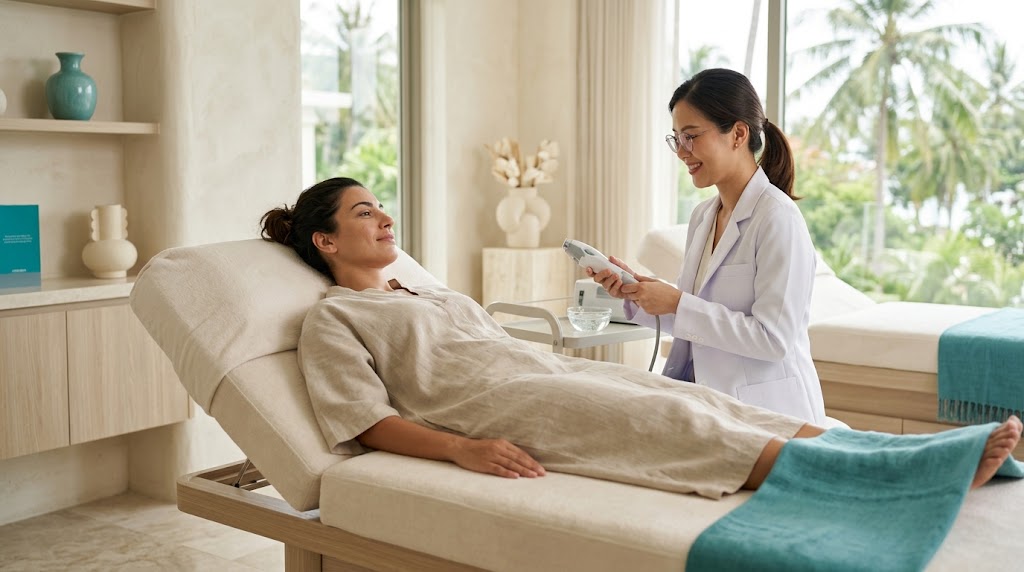
Warm prickles, a little deep heat, the occasional zing near bone — that is the honest answer.
Does HIFU hurt? HIFU is generally well tolerated rather than painful. Most people describe warmth, prickling or a deep tingling as the energy is delivered, with brief sharper sensations over bony areas; discomfort is the most commonly reported effect but it stops as soon as treatment ends.
What HIFU actually feels like
Warmth and prickling
Most people describe a warm, prickling or deep tingling sensation as each line of energy is delivered, coming in short bursts rather than continuously.
Brief and intermittent
Between pulses you feel nothing, so it is a series of brief sensations rather than sustained discomfort.
How much discomfort is normal
The evidence
A published study of HIFU on the face and neck found discomfort during the procedure was the most commonly reported effect, with transient redness afterwards.
It stops when treatment stops
Unlike recovery from an invasive procedure, HIFU discomfort ends essentially as soon as the session finishes.
Which areas feel more sensitive
Sensation varies by area:
- Over bone — jawline, brow and forehead can feel sharper
- Deeper depths — the deepest cartridges feel more intense
- Thin skin — around the eyes and neck can be more sensitive
- Body areas — generally better tolerated but take longer
Comfort at a glance
| Stage | What you feel |
|---|---|
| Before | Nothing; gel applied |
| During | Warm prickling, brief sharper zings |
| Immediately after | Warmth, mild redness |
| Next day | Usually mild tenderness at most |
Comfort varies considerably between people.
How comfort is managed
Settings and pacing
Your clinician can adjust energy levels and pacing, so tell them if a sensation is too intense — there is no benefit to enduring it.
Numbing where helpful
Topical numbing cream can be used for more sensitive areas or anxious patients, and taking treatment more slowly helps.
Newer devices are more comfortable
Improved delivery
Modern focused-ultrasound systems such as Ultraformer III are generally described as more comfortable than earlier HIFU devices.
Compared with alternatives
Compared to a thread lift (local anaesthetic, days of recovery), HIFU discomfort is brief and needs no downtime.
What about afterwards?
Mild at most
Afterwards you may feel mild tenderness, warmth or a slight ache in the treated area, settling within hours to a couple of days.
When to call
Severe or worsening pain is not typical — see our guide to HIFU side effects and report anything unexpected.
Making your treatment comfortable
To keep HIFU as comfortable as possible:
- Have a consultation and mention any anxiety about discomfort.
- Ask about numbing cream for sensitive areas.
- Arrive well hydrated and not on an empty stomach.
- Tell your clinician immediately if a sensation is too intense.
- Take short breaks if you need them during the session.
- Use a cool compress afterwards if the area feels warm.
Comfortable HIFU at LIV Clinic Koh Samui
At LIV Clinic, Dr. Narathai adjusts settings and pacing to keep HIFU comfortable while still effective. Explore our HIFU and skin-tightening treatments, read about how long results last, or book a consultation.
Frequently asked questions
Does HIFU hurt?
It is generally well tolerated rather than painful. Most people describe warm prickling or deep tingling in short bursts, with brief sharper sensations over bony areas like the jawline and brow.
Is HIFU more painful than other treatments?
It is usually less involved than a thread lift, which needs local anaesthetic and a few days of recovery. HIFU discomfort is brief, ends with the session, and needs no downtime.
Which HIFU areas hurt most?
Areas over bone — the jawline, brow and forehead — and the deepest energy depths tend to feel sharper. Thin-skinned areas like around the eyes and neck can be more sensitive.
Can I have numbing cream for HIFU?
Yes, topical numbing can be used for more sensitive areas or if you are anxious. Adjusting energy settings and pacing the session also helps considerably.
Does HIFU hurt afterwards?
Usually only mild tenderness, warmth or a slight ache, settling within hours to a couple of days. Severe or worsening pain is not typical and should be reported.
Are newer HIFU devices more comfortable?
Generally yes. Modern focused-ultrasound systems are typically described as more comfortable than earlier HIFU devices, while still delivering effective energy.
Safety and consultation
HIFU is a non-invasive, energy-based medical procedure and, like any device treatment, carries some risk — common temporary effects can include redness, mild swelling, tingling or tenderness, and less common reactions are possible. Results vary from person to person, and no specific outcome can be promised. This article is general information, not medical advice.
At LIV Clinic, every treatment begins with an in-person assessment by Dr. Narathai Vichienkalayarut, M.D., who reviews your skin, medical history and goals before recommending a personalized plan. Book a consultation to find out whether this treatment suits you.
LIV Clinic — “Live Your Life Young”
Doctor-led aesthetic and wellness clinic on Koh Samui and Koh Phangan, serving both international visitors and local residents.
Koh Samui (Bophut): 1/63 Thaweeratpakdee Rd, Bo Put, Koh Samui, Surat Thani 84320 · Tel 065-996-4242
Koh Phangan: 116/16 Moo 1, Koh Phangan, Surat Thani 84280 · Tel 093-254-5259
LINE: @Livclinic · Book a consultation
Explore our HIFU and skin-tightening and Thermage services.
ฆสพ.สฎ. 78/2567